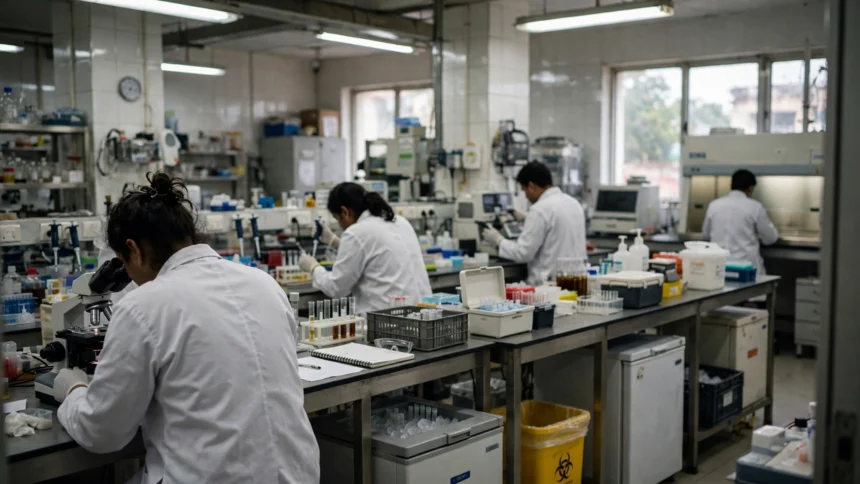
Indian medical research reached a milestone this week. The Indian Council of Medical Research (ICMR) has crossed 100 successful technology transfer deals, turning laboratory research into products that companies can manufacture and patients can actually use. The announcement came at the third Department of Health Research (DHR)-ICMR Health Research Excellence Summit, which concluded on Tuesday, November 17, at Bharat Mandapam in New Delhi.
The headline number is striking because of how fast it was reached. The 100 deals were completed in under two years, under an initiative called Medical Innovations Patent Mitra, launched by Union Health Minister J P Nadda in March 2025. For an organisation that has spent 115 years building India’s biomedical research base, the pace of the last two years marks a clear shift: research is no longer meant to sit in journals, it is meant to reach hospitals, clinics and pharmacies.
20 new licensing agreements signed at the summit
At the summit’s Technology Transfer Ceremony, ICMR exchanged 20 licensing agreements covering eight technologies with nine Indian companies. Those 20 deals took the cumulative count to 100, and they were the centrepiece of a two-day gathering that brought together more than 600 scientists, researchers, innovators, administrators and policymakers from ICMR institutes, partner institutions, government organisations and academia.
The summit also put the research itself on display. An Innovation Exhibition showcased 17 technologies developed by ICMR institutes and partner institutions, while a dedicated session presented 10 technologies and eight patents. The message was consistent across the two days: Indian labs are producing work that Indian industry is ready to take forward.
Three new initiatives launched
Beyond the licensing deals, the summit launched three initiatives aimed at closing the gap between research and real-world use:
- Research to Action Vertical: a new DHR unit that will turn research evidence into decision-ready products for policy and public health programmes, so findings reach government decisions faster.
- Syndromic Surveillance: an early-warning network for outbreaks, built under the DHR Virus Research and Diagnostic Laboratories (VRDL) scheme, covering 70 VRDLs and Infectious Disease Research and Diagnostic Laboratories (IRDLs) across the country.
- Dr M K Bhan Young Medical Faculty PhD Portal: a centralised digital platform with information for prospective PhD applicants in medical research, named after the late scientist Dr M K Bhan.
ICMR also released its Antimicrobial Resistance (AMR) Annual Report and Standard Operating Procedures, bringing together the national evidence base on drug resistance, and an ICMR Compendium featuring 25 stories of research translated into outcomes for people. A special session marked the golden jubilee of the ICMR-National Institute of Malaria Research, 50 years of work on malaria, and the top 100 school students selected through the SHINE National Competition were recognised for their scientific thinking.
Why it matters
The 100-deal milestone matters because it changes who benefits from Indian medical research, and how quickly. When a diagnostic test, a device or a treatment developed in a government lab is licensed to an Indian company, it can be manufactured at Indian prices, for Indian conditions, without waiting for an imported alternative. That is the practical difference between a research paper and a product on a pharmacy shelf, and it is why the speed here counts: 100 transfers in under two years is a pipeline, not a one-off.
The surveillance initiative may prove just as important over time. Seventy laboratories feeding early-warning signals into one network means outbreaks can be spotted while they are still small clusters, not after they have spread across districts. For a country that has lived through the cost of slow detection, that is a quiet but real upgrade to public health security.
There is also a longer story in the numbers. ICMR was established in 1911, making it one of the oldest medical research organisations in the world. Its 115th year is being marked not with a retrospective but with licensing deals, a PhD portal for young researchers and a school competition for the next generation. The test will be whether the next 100 deals arrive even faster, and whether the products they create reach patients at prices they can afford.
FAQs
What is a technology transfer deal?
It is an agreement under which a research institution licenses a technology it developed, such as a diagnostic kit or a medical device, to a company that manufactures and sells it. The company gets a proven product, and the research reaches patients.
What is the Medical Innovations Patent Mitra initiative?
It is ICMR’s flagship programme, launched in March 2025, to help researchers protect, develop and commercialise their innovations. All 100 technology transfer deals were completed within its first two years.
Which technologies were licensed at the summit?
The 20 new agreements cover eight technologies licensed to nine Indian companies. The individual technologies were not named in the official announcement, but 17 ICMR technologies were showcased at the summit’s Innovation Exhibition.
How does this help ordinary patients?
Licensed Indian-made diagnostics and treatments can reach the market faster and usually at lower prices than imported alternatives, which matters most for affordable testing and care in smaller towns and rural areas.
ICMR’s next test is delivery: turning these 100 agreements into products that doctors can prescribe and patients can afford. If the pace of the last two years holds, the milestone announced in New Delhi this week will look like a starting point, not a finish line.