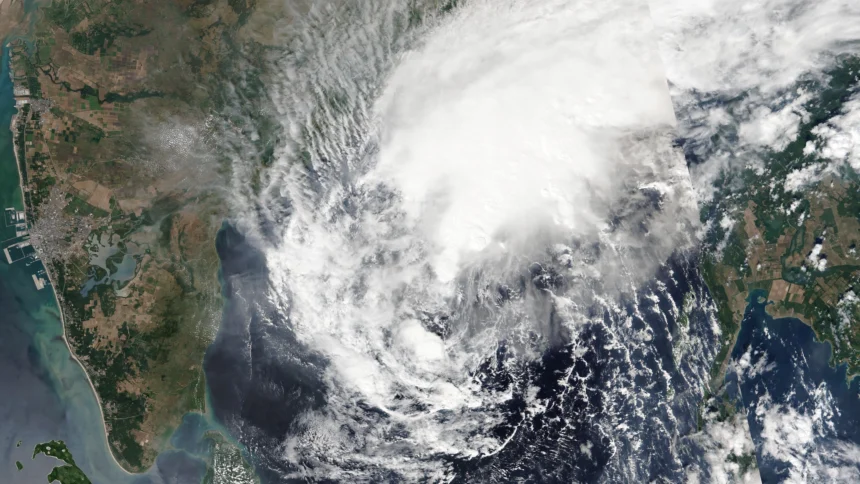
Cyclone Akvan crossed the Odisha coast near Gopalpur on Friday morning, bringing heavy rain and strong winds to the coastal districts after a night in which nearly three lakh people were moved to safety. The storm, which had been a severe cyclonic storm a day earlier, weakened before landfall and crossed the coast with winds of 70 to 80 kmph, gusting to 90 kmph.
By the time the landfall process began at around 7:30 am, Odisha had already shifted 2,98,676 people into 2,523 relief camps and readied 9,341 cyclone shelters across the affected districts. It is the third cyclone to threaten the state in 24 days.
How the morning unfolded
Akvan had been moving north-northwestwards across the Bay of Bengal through the week, with landfall forecast close to Gopalpur by Friday noon. The storm weakened faster than expected: around 2:30 am on Friday it dropped from a severe cyclonic storm to a cyclonic storm, and the land interaction began at about 7:30 am. The storm crossed the coast close to Gopalpur between 7:30 am and 8:30 am, and the IMD said the landfall process would continue for about two more hours.
Heavy rain lashed coastal Odisha, north Andhra Pradesh and parts of West Bengal through the morning. IMD Director General Mrutyunjay Mohapatra said the storm would cross the coast as a cyclonic storm, with winds of 70 to 80 kmph in Odisha and 90 to 100 kmph along parts of the Andhra Pradesh coast. The IMD issued a red alert for Srikakulam and Vizianagaram districts in Andhra Pradesh and warned of extremely heavy rainfall of 21 cm or more in coastal Andhra Pradesh and south Odisha over November 19 and 20.
Three lakh people, 423 rescue teams
The evacuation was the centrepiece of the state’s response. By Thursday evening, 2,98,676 people had been moved to safer places from 6,201 vulnerable locations across 253 blocks and towns in 20 districts. The government identified 941 landslide-prone locations across five districts and shifted residents of hilltop and foothill villages to shelters.
For rescue and restoration, the state deployed 423 teams, including 60 ODRAF units, 14 NDRF teams and 131 Fire and Emergency Services teams, and the Indian Coast Guard was asked to keep aircraft, vessels and rescue teams ready. Chief Minister Mohan Charan Majhi reviewed preparedness at the Special Relief Commissioner’s control room, with the administration working to a zero-casualty target.
The East Coast Railway cancelled 41 trains and rescheduled 29 others as a precaution, and schools were shut across the coastal districts. Telecom providers were told to activate intra-circle roaming in six coastal districts so mobile networks keep working if one operator’s towers go down.

Three cyclones in 24 days
Akvan is the third cyclone of the 2026 North Indian Ocean cyclone season, and the third to threaten Odisha in less than a month:
- Cyclone Arnab, October 28: made landfall on the Andhra Pradesh coast. Ten people died in landslides during that storm, a reminder that the danger often comes from rain and hillsides rather than wind alone.
- Cyclone Murasu, November 3: made landfall near Ongole in Andhra Pradesh, the second storm to hit the region in a week.
- Cyclone Akvan, November 20: formed as a low-pressure area on November 12, became a cyclonic storm on November 16 and intensified into a severe cyclonic storm on November 18 before weakening ahead of landfall near Gopalpur. The name Akvan was suggested by Iran under the regional cyclone naming system.
Akvan was a difficult storm to forecast: it stalled over the central Bay of Bengal on November 17, and its forecast landfall point shifted northwards with every IMD update. That uncertainty is part of why the evacuation was ordered early and spread wide.
Why it matters
The headline numbers tell only half the story. The other half is repetition. When the same coastal belt faces its third cyclone in 24 days, the strain is cumulative. Fishing boats have now lost a third stretch of working days, paddy in low-lying fields faces waterlogging for the third time in a month, and power lines and roads repaired after one storm are tested again by the next.
There is also a shift in where the risk sits. Arnab’s ten deaths came from landslides, not wind, and Akvan’s warnings have again centred on extremely heavy rain, flash floods and landslide-prone hillsides. Odisha’s evacuation machinery works: nearly three lakh people were moved before Akvan arrived. But the lesson of the last three weeks is that rain after landfall, not the landfall itself, is where the danger now concentrates.
For readers in the affected districts, the practical meaning is straightforward: rail and road links are disrupted today, schools are shut, and fishermen have been told to stay ashore. The next two days will be about water, how much rain falls on already soaked ground, and how fast power and road links come back once the winds drop.
What happens next
The IMD expects Akvan to move north-northeastwards and weaken rapidly. North coastal and interior Odisha could still receive heavy rain through Friday before conditions improve by Saturday, and damage assessment and restoration will begin once the winds drop, with rescue teams already in place to clear uprooted trees and blocked roads.
Residents have been urged to stay indoors and away from riverbanks and reservoirs until the administration gives the all-clear. With two cyclones already behind it this month, Odisha’s test now is not the landfall it prepared for, but the recovery that follows it.
FAQs
Where did Cyclone Akvan make landfall?
Near Gopalpur in Odisha, crossing the north Andhra Pradesh and south Odisha coast between 7:30 am and 8:30 am on Friday, November 20, 2026.
How strong was it at landfall?
It crossed as a cyclonic storm with winds of 70 to 80 kmph, gusting to 90 kmph, after weakening from a severe cyclonic storm during the night.
How many people were evacuated?
Nearly three lakh people, 2,98,676 by Thursday evening, were shifted to 2,523 relief camps and 9,341 cyclone shelters across Odisha.
Which areas are affected?
South coastal Odisha, north Andhra Pradesh districts including Srikakulam and Vizianagaram, and parts of West Bengal.
When will conditions improve?
Heavy rain is expected to continue through Friday, with conditions likely to improve by Saturday as the system weakens and moves inland.
Stay with Informeia for the latest updates on Cyclone Akvan and the relief work under way in Odisha and Andhra Pradesh.