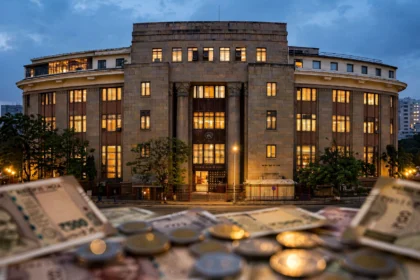
India’s foreign exchange reserves slipped again this week, falling by $1.269 billion to $719.748 billion, according to data released by the Reserve Bank of India (RBI) on Friday, October 30. The dip extends a slide from the record high touched in early September, and it comes at a time when the central bank has been active in the currency market to steady the rupee.
The latest numbers, published in the RBI’s Weekly Statistical Supplement, cover the week ended October 23. They show a mixed picture inside the reserves pile: the value of gold holdings fell sharply, while foreign currency assets, the largest component, actually rose. The net result was still a decline, the second weekly fall in a row after a $5.011 billion drop in the previous reporting week ended October 16, when reserves stood at $721.016 billion.
For ordinary readers, the reserves figure is best understood as the country’s financial buffer. It is the stock of foreign currency, gold and other assets the RBI holds, and it gives the central bank room to step in when markets turn rough. At nearly $720 billion, that buffer remains among the largest in the world, even after weeks of decline.
Gold down, foreign currency assets up
The break-up of the latest data explains why the headline number fell despite an increase in the biggest component. The value of gold reserves dropped by $2.65 billion during the week to $103.15 billion. That single fall was more than enough to outweigh a $1.358 billion rise in foreign currency assets, which climbed to $593.205 billion.
Foreign currency assets include holdings in currencies such as the euro, the pound and the yen, expressed in dollar terms, so their value moves with exchange rates as well as with actual inflows and outflows. The other components moved only marginally: Special Drawing Rights with the International Monetary Fund rose by $27 million to $18.605 billion, while India’s reserve position with the IMF eased by $4 million to $4.787 billion.
Despite the weekly decline, the overall position is still stronger than it was at the start of the financial year. RBI data show reserves remain $28.64 billion higher than their level at the end of March 2026, a reminder that the recent slide follows a period of very rapid accumulation.

Down from the September record
The reserves pile touched an all-time high of $785.706 billion in the week ended September 4. That peak was driven by a heavy flow of currency linked to a special concessional swap for deposits from the Indian diaspora, through which banks raised a record sum of nearly $133 billion. Since then, the trend has been downward.
Experts attribute the decline to two main factors. The first is the deployment of Foreign Currency Non-Resident (FCNR-B) resources raised through that swap window. The second is the RBI’s intervention in the foreign exchange market, selling dollars to support the rupee as it trades near record lows against the US currency. The rupee’s weakness, driven in part by high crude oil prices and global uncertainty, has kept the central bank busy through October.
The pattern is familiar to market watchers: reserves rise when foreign money pours in, and they are drawn down when the central bank leans against pressure on the currency. The question now is how long the current phase of drawdown lasts, and whether inflows pick up as the global mood improves.
Why the reserves number matters
A large reserves stock matters for three practical reasons. First, it reassures foreign investors that India can meet its external payments even in a shock. Second, it gives the RBI firepower to smooth sharp swings in the rupee rather than letting the currency free-fall. Third, it feeds into ratings and market confidence, which in turn affect borrowing costs for the government and companies.
That said, economists caution against reading too much into a single week’s move of around $1.3 billion. Weekly changes are often driven by valuation effects, such as a change in the dollar value of gold or of euro holdings, rather than by any sudden outflow. The broader trend over several weeks, and the level relative to import cover, tells a clearer story.
- Headline: Reserves fell $1.269 billion to $719.748 billion in the week ended October 23.
- Gold reserves: Down $2.65 billion to $103.15 billion, the main drag on the total.
- Foreign currency assets: Up $1.358 billion to $593.205 billion.
- Record high: $785.706 billion in the week ended September 4, 2026.
- Since March 2026: Reserves are still up $28.64 billion from end-March levels.
What to watch next
Traders will now watch the next weekly release, along with the rupee’s movement and crude oil prices, for signs of whether the drawdown is easing. A stabilisation in gold prices or a fresh round of foreign inflows could quickly change the direction of the headline number. For now, the RBI’s buffer remains deep, and the central bank has shown it is willing to use it.
FAQs
What are India’s forex reserves?
They are the foreign currency assets, gold, Special Drawing Rights and reserve position with the IMF held by the Reserve Bank of India, used to support the rupee and meet external payment needs.
Why did reserves fall this week?
Mainly because the value of gold reserves fell by $2.65 billion, which outweighed a $1.358 billion rise in foreign currency assets, according to RBI data released on October 30.
How far are reserves from their record high?
Reserves peaked at $785.706 billion in the week ended September 4, 2026, so the latest $719.748 billion figure is roughly $66 billion below that peak.
Does a fall in reserves affect ordinary people?
Not directly. But reserves give the RBI room to steady the rupee, and a stable rupee helps keep imported fuel and goods from getting costlier.
Where does the RBI publish this data?
In its Weekly Statistical Supplement, released every Friday, which breaks reserves down into foreign currency assets, gold, SDRs and the IMF reserve position.
India’s reserves story in 2026 has been one of a record peak followed by a steady, managed decline. The latest data show that decline continuing, but from a position of considerable strength.