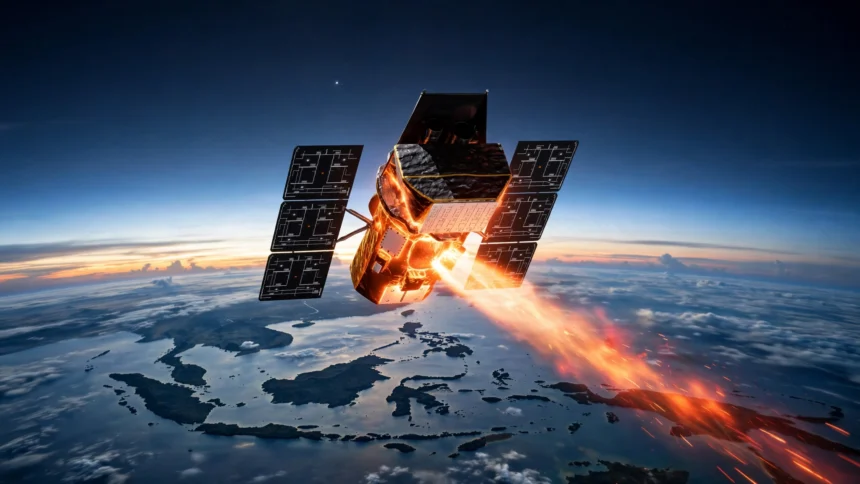
After nearly 22 years of chasing the most violent explosions in the universe, NASA’s Swift telescope came home the hard way. On Wednesday, November 4, the 1,452 kg observatory tumbled out of orbit and burned up over Indonesia, closing the book on a mission that was only supposed to last two years.
The US Space Force confirmed the re-entry at 7:39 am Eastern Time (6:09 pm IST), as Swift streaked into the upper atmosphere at roughly 22 times the speed of sound above Indonesia’s North Sumatra province. NASA said most of the spacecraft incinerated high above Earth, and no damage or injuries on the ground were reported.
Swift was the world’s fastest cosmic first responder, a telescope built to swivel toward a gamma-ray burst within seconds of its flash and tell telescopes everywhere exactly where to look.
A two-year mission that ran for 22 years
Swift launched from Cape Canaveral on November 20, 2004, aboard a Delta II rocket. Its job sounded simple but was fiendishly hard: catch gamma-ray bursts, the brief, blinding flashes released when massive stars collapse or dead stars collide.
To do it, Swift carried three instruments working as a team. Its Burst Alert Telescope watched a huge slice of sky at once, waiting for a flash. When one appeared, the spacecraft spun itself around in under a minute so its X-ray and ultraviolet telescopes could study the fading afterglow. Before Swift, most bursts vanished before anyone could point a telescope at them. After Swift, they became some of the best-studied events in the cosmos.
The numbers tell the story of an overachiever. Swift detected more than 2,000 gamma-ray bursts, spotted over 1,400 supernovae, and watched stars being torn apart by black holes. Around 7,000 research papers were built on its data, and its ultraviolet telescope alone captured more than 1.5 million images.
The bursts that made history
Two of Swift’s catches stand out. In May 2005, barely six months after launch, it captured GRB 050509B, a short burst lasting just 0.03 seconds, less time than a blink. It helped confirm that short bursts come from colliding neutron stars.
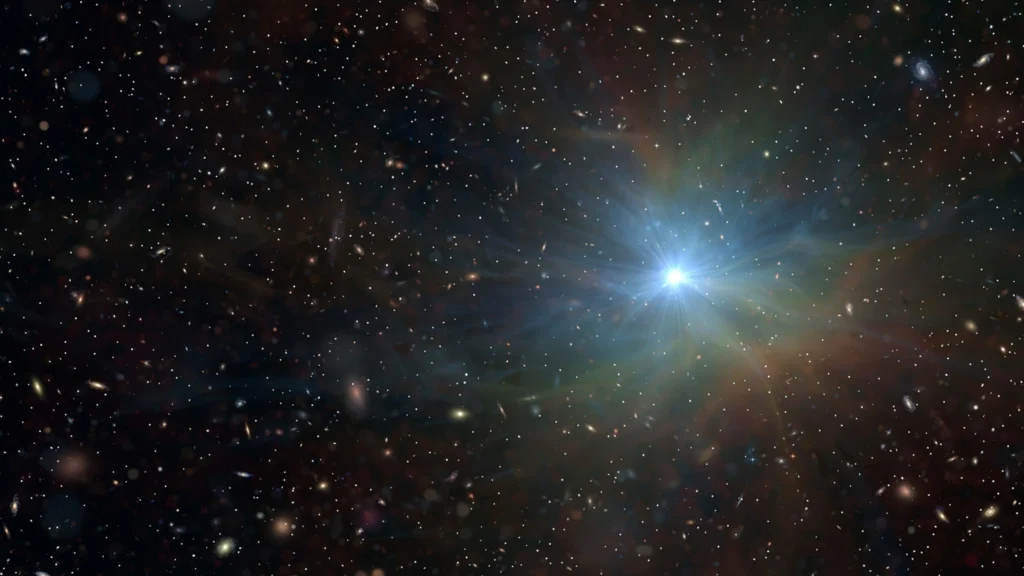
Then, on October 9, 2022, came the BOAT, the brightest of all time. It was the most luminous gamma-ray burst ever recorded, so powerful that it lit up detectors across the solar system. Swift was at the heart of that global observing effort too.
Why it had to come down
Swift’s end was not caused by a broken instrument. It was physics. The spacecraft had no propulsion system to fight back against atmospheric drag, and an unusually active Sun made things worse. During the intense peak of Solar Cycle 25 between 2024 and 2026, solar radiation heated and puffed up Earth’s upper atmosphere, increasing the drag on everything in low orbit.
Swift sank steadily through 2026. By October 20, it had dropped below 275 km and made its final observation. Three days later, on October 23, NASA formally ended the mission and shut the spacecraft down.
There was one last hope. In July 2026, a commercial robotic spacecraft called LINK, built by Katalyst, launched from Kwajalein Atoll in the Marshall Islands. Its job was to grab Swift and boost it to a safer orbit. But LINK malfunctioned, lost steering, burned through fuel trying to regain control, and itself burned up in September 2026.
A fiery, harmless finale
With no rescue possible, the fall was only a matter of time. Forecasters had narrowed the re-entry window to Wednesday morning Eastern Time, and the actual plunge landed comfortably inside it. The debris path stretched across a broad band around the equator, but most of it lay over open ocean, and the final fall came over western Indonesia without incident.
It was a fittingly dramatic exit for a telescope that spent its life watching explosions. Swift’s archive, roughly 12 terabytes of data covering nearly 22 years of cosmic outbursts, remains open to researchers.
Swift was built for two years. It gave science 22. Few machines in history have outperformed their warranty quite so spectacularly, and fewer still have bowed out with fireworks.
FAQs
What was NASA’s Swift telescope?
Swift, formally the Neil Gehrels Swift Observatory, was a NASA space telescope launched in 2004 to detect gamma-ray bursts and study their afterglows.
When and where did Swift re-enter Earth’s atmosphere?
Swift re-entered on November 4, 2026, at 7:39 am Eastern Time (6:09 pm IST), over Indonesia’s North Sumatra region, according to US Space Force tracking confirmed by NASA.
Was anyone at risk from falling debris?
The risk was calculated at about one chance in 2,100. NASA reported no damage or injuries, and most of the spacecraft burned up during re-entry.
Why did the Swift mission end?
Swift had no propulsion and its orbit decayed, worsened by drag during an active solar cycle. Below 275 km it could no longer hold a steady aim, so NASA ended operations on October 23, 2026.
What happened to the rescue mission?
A commercial spacecraft called LINK was sent in July 2026 to boost Swift to a higher orbit, but it malfunctioned and burned up in September 2026, ending the rescue attempt.
Swift was built for two years and gave science 22. Its archive of cosmic explosions will keep astronomers busy long after its final plunge.