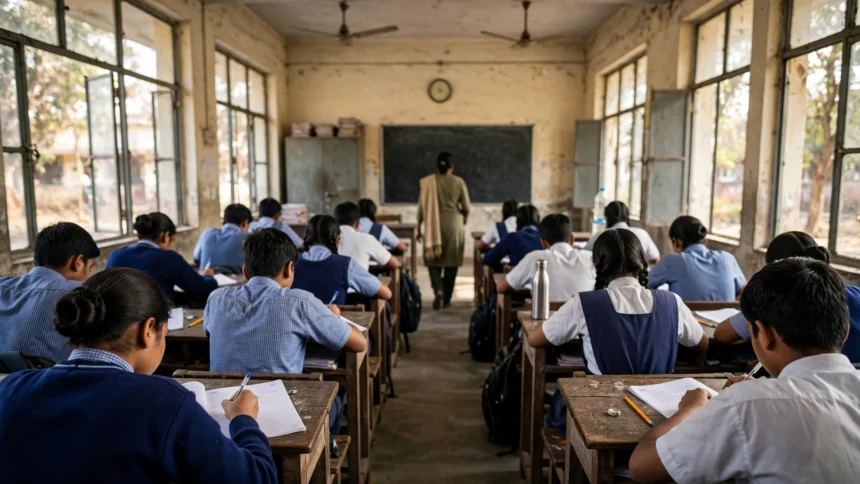
For lakhs of students currently in Class 9, the road to the Class 10 board examinations in 2028 just got a lot clearer. The Central Board of Secondary Education (CBSE) has spelled out the Scheme of Studies for that batch, and the headline message is reassuring: five compulsory board papers, a real choice in vocational education, and a safety net that could save a result if one core subject goes wrong.
The clarification, issued to school principals on October 29, 2026, applies specifically to students studying in Class 9 in the 2026-27 session. They will move to Class 10 in 2027-28 and sit the board examinations in 2028. Students already in Class 10 this year are not affected, and the existing scheme continues for them.
The board said the circular was meant to remove confusion about how many subjects students were actually expected to study.
Five compulsory papers, nine subjects to study
Under the 2028 scheme, students will have five compulsory board examination subjects: two languages, mathematics, science and social science. That is the core on which the Class 10 result will rest.
At the same time, students will study nine compulsory curricular subjects in all. Alongside the five board papers, the list includes a third language, art education, physical education and well-being, and vocational education. In other words, the classroom load is broader than the board examination load, but only five subjects will decide the board result in the usual way.
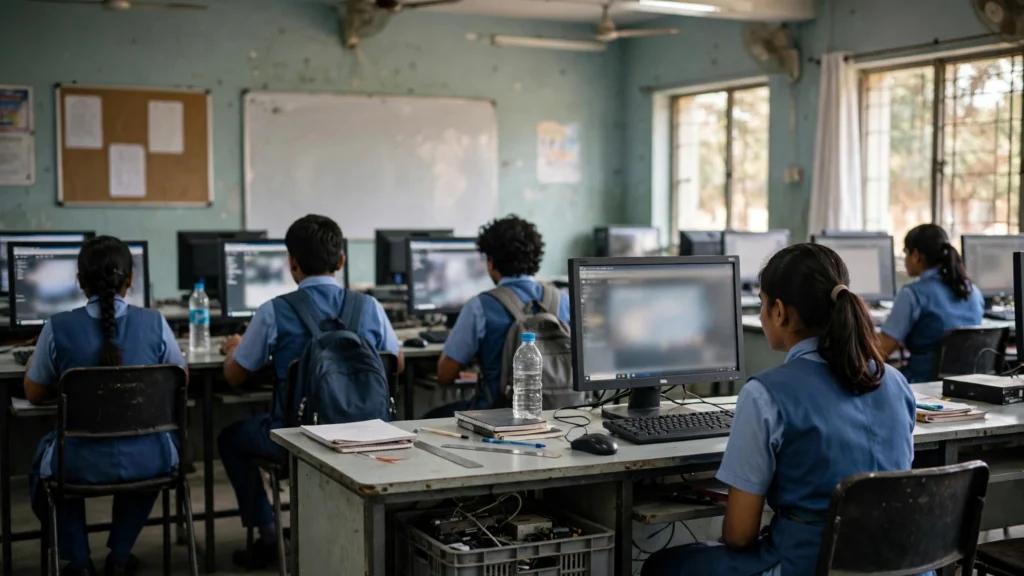
The vocational choice: Kaushal Vikas or a skill subject
Vocational education remains compulsory for the 2028 batch, but students get a genuine choice in how they meet it. They can opt for the subject called Kaushal Vikas, or pick any one of 22 skill subjects notified by the board.
The two routes work differently, and students should understand the difference before choosing:
- Kaushal Vikas: assessed within the school. Students need at least 33 percent marks to get a school certificate, and they do not have to appear for a board examination in the subject.
- A skill subject: examined by the board in Class 10. The notified options include artificial intelligence, data science, information technology, financial markets, healthcare and design thinking, among others. Students who pass receive certification under the National Skills Qualifications Framework (NSQF).
The skill-subject route carries an extra advantage that has caught the attention of students and teachers alike. If a student fails in any one of mathematics, science or social science but passes the skill subject, the skill subject can replace the failed subject while computing the Class 10 result. It is a safety net, not a shortcut: the student still has to pass the skill paper, and the rule applies to one failed core subject.
What has been left out for this batch
The board has also confirmed what will not be part of the curriculum for these students. The subject called Individuals in Society and the Modules of Computational Thinking (CT) and Artificial Intelligence in Class 9 (2026-27), and Environmental Education in Class 10 (2027-28), will not be included in the Scheme of Studies for this batch.
CBSE said this was done to align the introduction of these areas with the implementation schedule. For schools, it removes a layer of uncertainty about whether to timetable and assess subjects that were introduced after the session had begun.
The circular was signed by Praggya M. Singh, Director (Academics) at CBSE, and sent to principals and heads of affiliated schools.
What students should do now
For a Class 9 student, the practical steps are worth taking this term rather than leaving them to Class 10:
- Confirm with your school which of the 22 skill subjects it offers, since availability will vary from school to school.
- Weigh Kaushal Vikas against a board-examined skill subject honestly. A skill paper adds an examination, but it also adds a recognised certificate and the replacement safety net.
- Do not relax on the five core papers. The safety net helps in one subject only, and the core subjects still carry the result.
- Keep an eye on your school’s subject-choice form and deadlines, because the vocational choice made now will carry into Class 10.
FAQs
Who does the CBSE 2028 Class 10 scheme apply to?
It applies to students in Class 9 in 2026-27 who will appear for Class 10 board examinations in 2028. The current Class 10 batch is not affected.
How many compulsory board papers will there be in 2028?
Five: two languages, mathematics, science and social science.
What is the choice in vocational education?
Students can choose Kaushal Vikas, assessed in school, or one of 22 notified skill subjects, examined by the board with NSQF certification on passing.
Can a skill subject really save a failed core paper?
Yes, in a limited way. If a student fails in one of mathematics, science or social science but passes the board-examined skill subject, the skill subject can replace the failed subject in the result calculation.
Which subjects have been dropped for this batch?
Individuals in Society and the CT and AI modules in Class 9, and Environmental Education in Class 10, will not be part of the Scheme of Studies for this batch.
CBSE’s message, in short, is plan early, choose the vocational route honestly, and keep the focus on the five core papers. The 2028 examinations are still some distance away, but the shape of the challenge is now clear.