
India took a quiet but important step in medical research on Monday, November 23, when Union Health Secretary Punya Salila Srivastava inaugurated the country’s first dedicated Human Metabolic Chamber Facility at Christian Medical College (CMC), Vellore. The facility, built jointly by the Tata Institute of Fundamental Research (TIFR) and CMC Vellore, is designed to answer a question that touches almost every Indian household: how does the Indian body actually use the food it eats?
For years, much of the science behind diet charts and diabetes advice in India has rested on studies done abroad. This chamber is meant to change that, by producing hard, India-specific evidence.
What exactly is a metabolic chamber?
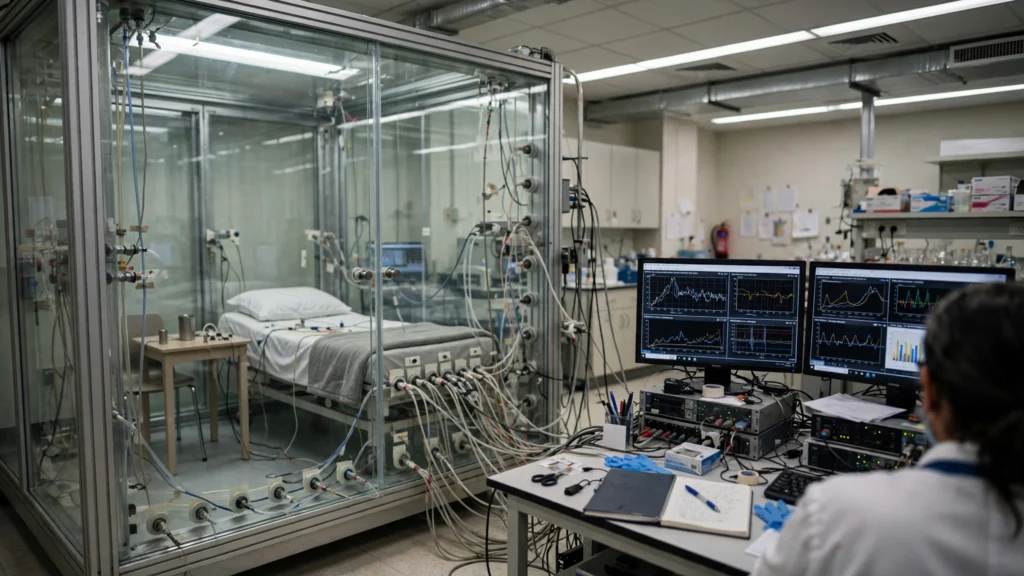
A human metabolic chamber is a room-sized calorimeter. A volunteer lives, eats and sleeps inside the sealed room for 24 hours or longer, while sensors measure the oxygen consumed and the carbon dioxide produced.
From those two measurements, scientists can calculate how much energy the body burns, and how much comes from fat and how much from carbohydrates, at rest and during everyday activity. It is the gold standard for
measuring human metabolism, far more precise than wearable devices or questionnaire-based estimates.
Who built it, and who was there
The facility brings together two institutions with very different strengths: TIFR’s Advanced Research Unit on Metabolism, Development and Ageing (ARUMDA), and CMC Vellore’s Department of Endocrinology, Diabetes and Metabolism.
The collaboration is supported by the Department of Atomic Energy, and industry partner Hindustan Unilever Limited has also backed the facility. The inauguration was attended by the directors of CMC Vellore and TIFR, senior scientists from both institutions, and Nico Schiettekatte, Health Counsellor at the Embassy of the Kingdom of the Netherlands.
Why it matters
Here is the gap this chamber is meant to close. Most of the numbers behind India’s dietary guidance, from calorie recommendations to diabetes risk scores, were developed from research on Western populations eating Western diets. Indian diets, genetics, body types, climates and daily routines are different, so advice built on foreign data does not always fit Indian bodies.
That mismatch has real consequences. India carries one of the world’s largest diabetes burdens, and obesity is rising fast in cities and towns alike. Yet doctors and nutritionists have had little India-specific data on the most basic question: how many calories does an Indian adult actually burn in a normal day, and how does that change with a rice-based diet versus a wheat-based one, or with shift work, or with age? The Vellore chamber lets researchers test those questions directly, on Indian volunteers, under controlled conditions, instead of borrowing answers from studies done elsewhere.
Over time, that should feed into dietary guidelines and diabetes prevention programmes that actually reflect Indian realities. The chamber will also study malnutrition and ageing, two areas where India faces a double burden: undernutrition in some groups and overnutrition in others.
The wider prevention push
The inauguration fits into a broader shift in India’s health policy, from treating illness towards preventing it. At the event, the Health Secretary pointed to the scale of that push: 1.87 lakh Ayushman Arogya Mandirs now provide primary healthcare and screening, and more than 7.8 crore yoga sessions have been held at these centres.
The government has also taken up Prime Minister Narendra Modi’s call for a 10 per cent reduction in cooking oil consumption, through measures including Sugar and Oil Boards and the ‘Aaj Se Thoda Kam’ campaign. Five more diseases, including chronic obstructive pulmonary disease (COPD), stroke and chronic kidney disease, are set to be covered under the National Programme for Non-communicable Diseases. The metabolic chamber adds a research backbone to that prevention agenda: campaigns can tell people to eat less oil and move more, but only facilities like this one can measure precisely what those changes do inside the body.
What happens next
The facility will now begin studies on metabolism, nutrition, diabetes, obesity, malnutrition, ageing and cancer care across India’s diverse populations, diets and lifestyles, building India-specific evidence for doctors and policymakers. For ordinary readers, the effects will not arrive overnight, but the next diet chart or diabetes guideline with an Indian stamp on its evidence may well trace back to a sealed room in Vellore.
Frequently asked questions
What is a human metabolic chamber?
It is a sealed, room-sized calorimeter. A volunteer lives, eats and sleeps inside for 24 hours or longer while sensors measure oxygen intake and carbon dioxide output, letting scientists calculate exactly how much energy the body burns.
Why does India need its own metabolic chamber?
Most existing metabolic data comes from Western populations. Indian diets, genetics and lifestyles differ, so India needs its own measurements for dietary and diabetes guidance that fits Indian bodies.
Is the chamber a treatment centre for patients?
No. It is a research facility. Volunteers take part in scientific studies under medical supervision; it is not a clinic where patients go for treatment.
Where is the facility located?
At Christian Medical College (CMC), Vellore, in Tamil Nadu, set up jointly by the Tata Institute of Fundamental Research (TIFR) and CMC Vellore.
What will the research change for ordinary people?
Over time, it should lead to India-specific advice on diet, calories and diabetes prevention, replacing guidance borrowed from studies done on very different populations.
It may look like a quiet laboratory opening, but its real test will come in the quality of the health advice it helps produce.