A fresh political row erupted on Thursday after Congress leader Rahul Gandhi described Indian democracy as “sick” during an event in the United States, drawing a sharp counter-attack from the Bharatiya Janata Party. The BJP accused the Leader of the Opposition of maligning India on foreign soil, while Gandhi insisted the Opposition would keep contesting elections.
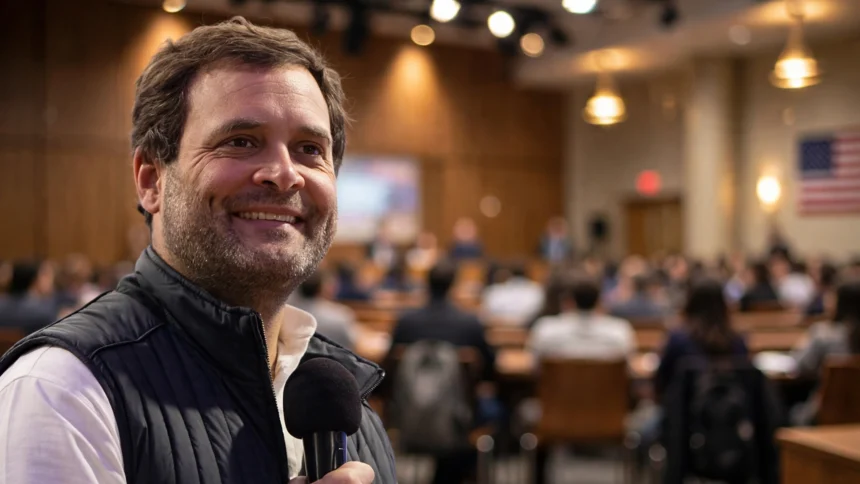
Gandhi made the remarks on Wednesday at the University of Chicago, during an interaction titled “The Iran War and India’s Role in the World”, moderated by political science professor Robert Pape. A video clip of the exchange circulated widely on social media on Thursday morning, and within hours it had become the day’s biggest political flashpoint back home.
What Rahul Gandhi said in Chicago
Speaking to students and faculty, Gandhi said the state of Indian democracy worried him deeply. “Indian democracy is sick. For me to even say that there is a problem in Indian democracy is difficult without 100, 200, 300 per cent proof,” he said.
He also ruled out any boycott of elections, arguing that walking away would itself damage democracy. “If we say that we are not going to contest elections, we end Indian democracy that very minute,” he said. Gandhi added that the Opposition was “not ready to accept a non-democratic India”.
The Columbia remarks a day earlier
The Chicago comments came a day after Gandhi addressed students and faculty at Columbia University in New York on Tuesday, where his focus was the economy. “The blunt thing is that India is sitting on an economic disaster. That is the reality. One can brush it aside, the media can brush it aside, but India has got a massive unemployment problem. India has got a massive problem with its education system,” he said.
The two appearances were part of a two-day visit to the United States. The combination of the two sets of remarks, one on the economy and one on democracy, gave the BJP two separate targets to respond to, and the party used both.

How the BJP responded
The BJP’s response on Thursday was swift. Party spokesperson Pradeep Bhandari shared the video of Gandhi’s Chicago remarks on X and accused him of working against India’s interests. “Every time Rahul proves that he is against the Indian state, the people of India and India’s democratic fabric. Rahul Gandhi is the Leader of Anti-India Propaganda,” Bhandari wrote, adding that Gandhi had “once again demonstrated that he loves Parivar, and hates Democracy”.
Union Parliamentary Affairs Minister Kiren Rijiju also weighed in, saying Gandhi should show responsibility while speaking about India abroad. “No true Indian would want any Indian to go abroad and make nonsensical statements about India,” he said. He questioned how the Opposition could protest and criticise the government all day if democracy did not exist in the country.
Rijiju countered with International Monetary Fund figures, asserting that more than 50 crore people had moved out of extreme poverty in India between 2011 and 2023.
Why it matters
This row is about more than one speech. It sits at the intersection of two arguments that have defined Indian politics for the past year: the Opposition’s campaign alleging flaws in the electoral rolls, and the government’s claim that India is the world’s fastest-growing major economy. Gandhi’s remarks abroad give both sides fresh material.
For readers, the practical consequence is noise. When the two sides trade charges like this, the underlying questions, how clean are the voter rolls, and how strong is job creation, get buried under slogans. What the Election Commission says about the specific allegations, and the jobs data behind the economic claims, matter far more than the labels exchanged on social media.
A familiar pattern
There is a clear timeline to this visit, and a longer history behind it:
- Tuesday, 17 November: Gandhi speaks at Columbia University in New York, calls India an “economic disaster” and flags unemployment and the education system.
- Wednesday, 18 November: Gandhi speaks at the University of Chicago, calls Indian democracy “sick” and rules out an election boycott.
- Thursday, 19 November: The BJP hits back, with Bhandari and Rijiju leading the attack.
This is not the first time Gandhi has used a foreign university platform to raise questions about Indian democracy. In March 2023, he spoke at Cambridge University on similar themes, and the BJP’s reaction then was much the same. The pattern is now familiar: a speech abroad, a clip on social media, a sharp BJP response, and a day of headlines.
FAQs
What exactly did Rahul Gandhi say in the US?
At the University of Chicago on Wednesday, he said “Indian democracy is sick”. A day earlier at Columbia University, he said India was “sitting on an economic disaster” because of unemployment and problems in the education system.
Will the Opposition boycott elections?
No. Gandhi said clearly in Chicago that the Opposition would keep contesting elections, arguing that refusing to contest would itself end Indian democracy.
How did the BJP respond?
BJP spokesperson Pradeep Bhandari called Gandhi the “Leader of Anti-India Propaganda”, while minister Kiren Rijiju said Gandhi should act responsibly abroad and cited IMF data on poverty reduction.
Why is this row significant?
It revives the debate over electoral integrity and the economy, two issues that have dominated Indian politics since the 2024 general election.
The row is likely to run for a few more days. What will matter most is whether either side moves beyond the slogans to the evidence.