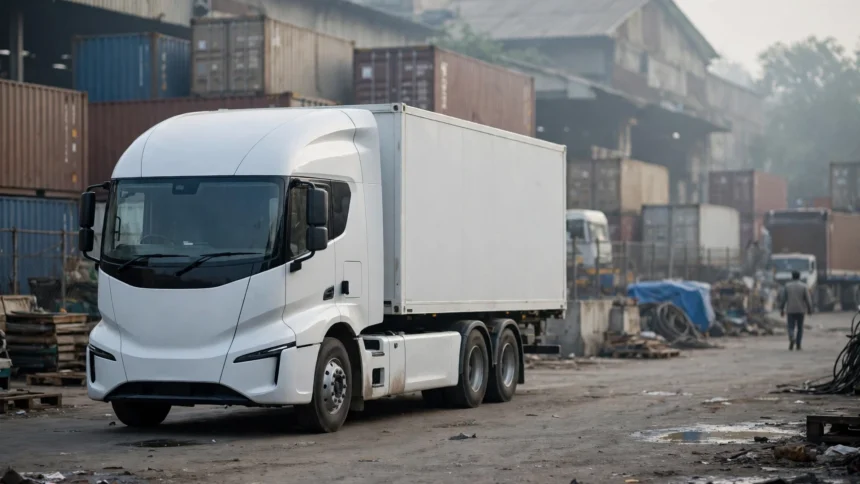
Delhi saw the first of them roll out on Tuesday, and the plan behind them is much bigger than one city. Tata Motors and Amazon have announced a plan to deploy 3,000 electric trucks across Amazon’s transportation network in India, a move the companies describe as the largest electric truck deployment by an e-commerce company in the country.
The first batch was flagged off in Delhi on Tuesday, October 27, by H. D. Kumaraswamy, the Union Minister for Heavy Industries and Steel. The rollout will begin in Delhi during the festive season, when shipment volumes typically rise, and then expand to major highways.
What makes this different from the electric delivery vans already common in Indian cities is where these trucks will work. They are meant for the middle mile: moving shipments between facilities, across cities and along national freight corridors. That longer, heavier middle leg is where diesel trucks have long dominated.
How the partnership will work
Tata Motors will supply the electric trucks, while Amazon’s carrier partners will own and operate them. Amazon brings steady freight demand from its logistics network, Tata Motors brings engineering, manufacturing and service support, and the carrier partners take on ownership and day-to-day operation.
Rajesh Kaul, vice-president and business head for trucks at Tata Motors, said the company was going beyond vehicle deployment to provide charging infrastructure, servicing and operational support. Abhinav Singh, vice-president for operations at Amazon for APAC, West Asia, Africa and Turkey, said electrifying the logistics network was an important part of Amazon’s goal to reach net-zero carbon emissions by 2040.
Amazon said it already operates more than 15,000 electric vehicles across more than 500 cities in India, mostly on last-mile work. This programme pushes electrification into the part of the network where loads are heavier, distances are longer and charging must be planned around highway routes.
The trucks starting the rollout
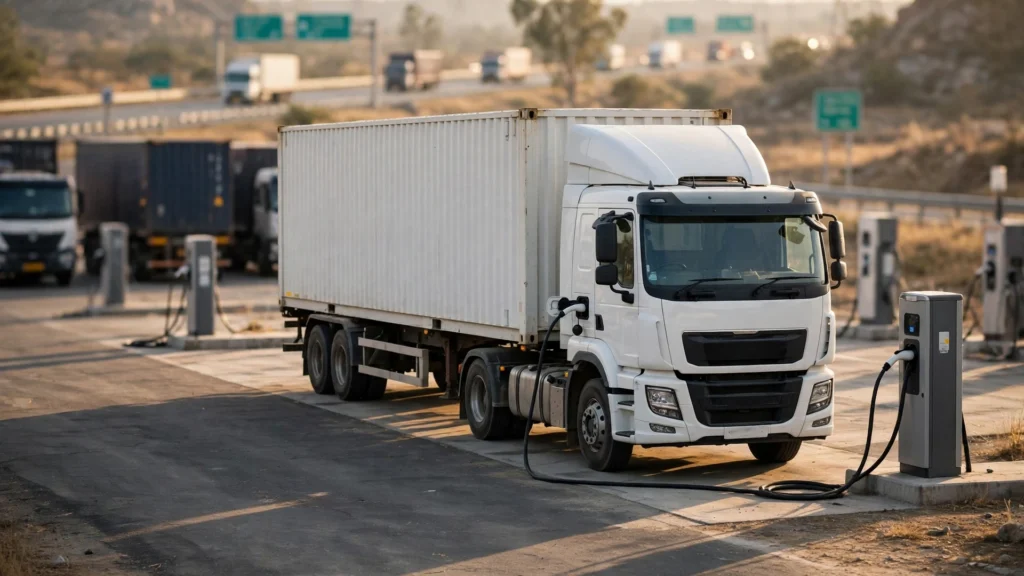
The initial deployment will use light and medium-duty electric trucks from Tata Motors, starting with the Tata Ultra E.7. The model comes with CCS2 fast charging, regenerative braking and a crash-tested cabin with high-voltage safety systems, features suited to urban and regional freight work.
For carrier partners, the practical questions are familiar: range on a charge, charging time, and time off the road. The companies have not published a single range or charging figure for this deployment, and those answers will depend on load, route and charging hub use.
A 2,800-km corridor on the drawing board
The most ambitious part of the announcement is the next phase: electrifying a 2,800-km Delhi-Bengaluru-Chennai corridor along National Highway 48. The route spans seven states and connects six of India’s largest e-commerce regions, and it carries the steady, high-volume freight that can justify dedicated charging infrastructure.
Charging hubs being developed with provider Yahhvi will support the expansion, building on 10 charging yards already developed for Amazon across India. A corridor only works if a truck can charge reliably on the route, not just at either end.
Delhi’s policy backdrop helps the first phase. Under Delhi’s 2026 EV Policy, the first 1,000 privately owned medium-duty electric trucks registered within three months of the policy’s launch will be allowed to enter the city at any time of day for 10 years, bypassing the usual No Entry restrictions.
Why the government is backing it
Kumaraswamy said India was accelerating towards electric mobility and the goal of Viksit Bharat 2047, and described the collaboration as sustained demand from a nationwide logistics network met by electric trucks manufactured in India. He pointed to schemes such as PM E-DRIVE, PLI Auto and PLI ACC, and said the government would continue to support the transition. The deployment also sits alongside PARIVARTAN, the broader push towards cleaner mobility and freight electrification.
What to watch next
- How quickly the Delhi rollout scales beyond the first batch, and whether carrier partners take up the trucks at the pace expected.
- Whether charging hubs along NH48 arrive in time to support the corridor, and how charging downtime affects schedules.
- How the trucks perform on loaded, real-world routes against diesel equivalents on cost, uptime and maintenance.
- Whether other large fleet operators follow with similar middle-mile electric truck orders once operating data is visible.
Three thousand trucks will not transform Indian freight overnight, but they move electrification into the middle of the supply chain, where most kilometres are driven. If they run reliably through the festive season and onto the corridor, they will give other operators proof at scale.
FAQs
How many electric trucks will Tata Motors and Amazon deploy?
The companies plan to deploy 3,000 electric trucks across Amazon’s transportation network in India.
Where did the rollout begin?
The first batch was flagged off in Delhi on Tuesday, October 27, 2026, by Union Minister H. D. Kumaraswamy, for Amazon’s middle-mile network in Delhi.
Which trucks are being used first?
Light and medium-duty Tata Motors electric trucks, starting with the Tata Ultra E.7, with CCS2 fast charging, regenerative braking and a crash-tested cabin.
What is the 2,800-km corridor?
The companies aim to electrify the Delhi-Bengaluru-Chennai corridor along NH48, spanning seven states and six large e-commerce regions, with Yahhvi charging hubs.
Who will own and operate the trucks?
Tata Motors will supply them, while Amazon’s carrier partners will own and operate them, with charging, servicing and operational support from Tata Motors.
The trucks flagged off in Delhi on Tuesday are a first step. The corridor, the charging network and the carrier partners will decide whether they become a turning point for green freight in India.