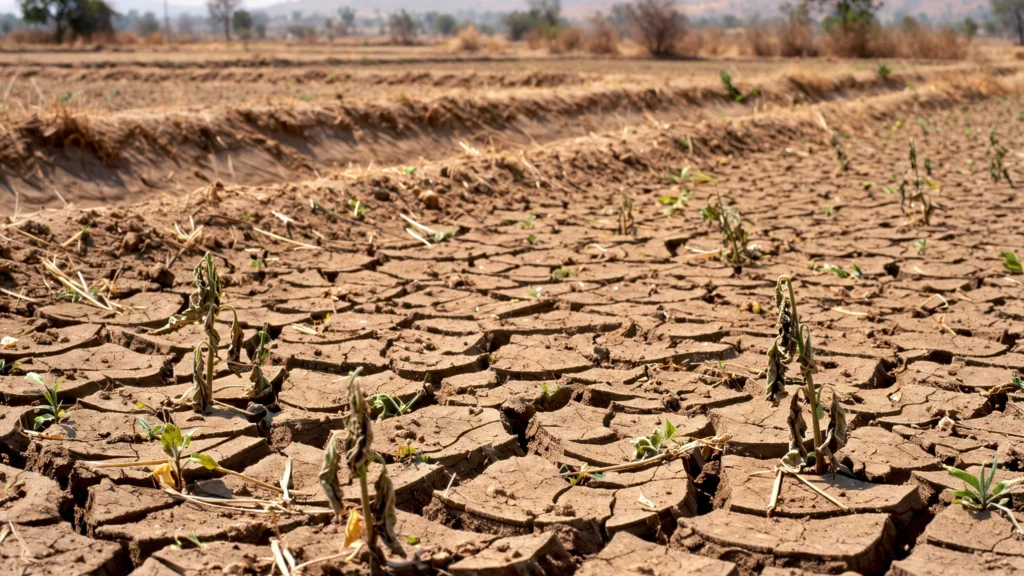
Maharashtra is facing a drought worse than the one in 1972. Only 14.74 lakh hectares have been sown so far in the 2026-27 Rabi season, far below the 47.29 lakh hectares sown during the devastating drought of 1972-73, according to the state Agriculture Department. The numbers point to what could become the lowest Rabi sowing season in the state’s recorded history.
The department has kept Rabi sowing records since 1960. Against a normal average of 55 to 60 lakh hectares, this year’s sowing is running at roughly a quarter of the usual area.
The numbers behind the crisis
The gap with 1972 is stark in almost every crop group. Food grain sowing stands at 7,79,812 hectares this year, against 36,64,000 hectares in 1972-73. Oilseeds have collapsed to just 16,106 hectares, compared with 6,34,000 hectares in that drought year. Pulses are the one exception, with 6,78,385 hectares sown against 4,31,000 hectares in 1972-73.
The previous record for the lowest Rabi sowing was 40 lakh hectares in 1991-92. This year’s figure is already far below that, and the season is more than halfway through its normal sowing window.
By November 16, only 10.02 lakh hectares had been covered, barely 17 per cent of the state’s normal average sowing area of 57.80 lakh hectares. By November 17 last year, Rabi sowing had covered about 16.51 lakh hectares. The latest update puts the figure at 14.74 lakh hectares, so sowing has picked up only slightly since.
Why this year is different
The immediate cause is the monsoon. The India Meteorological Department and global weather organisations have declared the active El Nino in the Pacific Ocean a powerful Super El Nino, and its direct impact on the monsoon left Maharashtra with a 19 per cent rainfall deficit compared with the average. Solapur recorded the sharpest drop, at 59 per cent below normal.
The failed monsoon hit twice over. The Kharif season failed first, and acute drinking water shortages in rural areas have since slowed Rabi sowing to a crawl.
What the government is doing
On November 19, Relief and Rehabilitation Minister Makarand Jadhav-Patil announced six more talukas added to the list of drought-affected regions, taking the total number of drought-hit talukas in the state for the Kharif 2026 season to 310. The state had earlier declared 304 talukas drought-affected based on rainfall deficit and other parameters.
State Agriculture Minister Dattatray Bharane said the government and the Agriculture Department are planning meticulously to tackle the impending crisis. The declaration of 310 talukas as drought-affected opens the way for relief measures, including water supply, fodder for cattle and employment support in the worst-hit areas.
Why it matters
A failed Rabi season in Maharashtra is not a local story. The state is a major producer of food grains, pulses and oilseeds, and a sharp drop in sowing now means a smaller harvest in the spring. That feeds directly into food prices at a time when they are already under pressure: retail food inflation stood at 8.94 per cent in October, and overall retail inflation had crossed the Reserve Bank’s 6 per cent tolerance limit.
For farm households, the damage is more immediate. A failed Kharif followed by a thin Rabi means two seasons of lost income in a row, in districts where farming is often the only livelihood.
There is also a longer question here. The 1972 drought became the benchmark for farm distress in Maharashtra, and the state built its relief systems around it. This year has gone past that benchmark on sowing, which suggests the systems built for a 1972-scale crisis may need to stretch further than they were designed for.
Maharashtra’s Rabi sowing in numbers
- 14.74 lakh hectares: Rabi sowing so far in 2026-27, against a normal average of 55 to 60 lakh hectares.
- 47.29 lakh hectares: Rabi sowing in the 1972-73 drought season, more than three times this year’s figure.
- 40 lakh hectares: The previous record low, set in 1991-92.
- 7,79,812 hectares: Food grain sowing this year, against 36,64,000 hectares in 1972-73.
- 16,106 hectares: Oilseed sowing this year, against 6,34,000 hectares in 1972-73.
- 310 talukas: Declared drought-affected for the Kharif 2026 season, after six more were added on November 19.
- 19 per cent: Maharashtra’s monsoon rainfall deficit, with Solapur 59 per cent below normal.
FAQs
How bad is Maharashtra’s drought this year?
Rabi sowing has reached only 14.74 lakh hectares so far, below the 47.29 lakh hectares sown in the 1972-73 drought and well under the previous record low of 40 lakh hectares in 1991-92.
What caused the drought?
A powerful Super El Nino cut Maharashtra’s monsoon rainfall by 19 per cent. The Kharif season failed, and drinking water shortages have since slowed Rabi sowing.
Which areas are worst affected?
Solapur recorded rainfall 59 per cent below normal. In all, 310 talukas have been declared drought-affected for the Kharif 2026 season.
Will sowing recover by December?
Experts see virtually no possibility of the total crossing 20 to 25 lakh hectares by the end of December.
What does this mean for food prices?
A smaller Rabi harvest in the spring can keep food prices high. Food inflation was already at 8.94 per cent in October.
Maharashtra has seen bad droughts before, but the sowing numbers say this one is worse than the benchmark year of 1972.