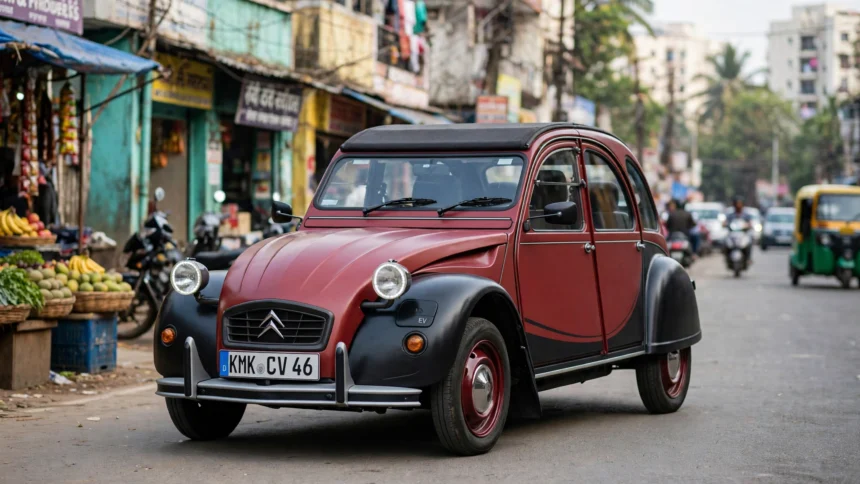
It is one of motoring’s most recognisable shapes: round headlights, a curved roof, a cheerful stance. Now the Citroen 2CV could be heading back to the production line, and the surprise is where it might be built. Fresh reports over the weekend say Citroen is evaluating India as the global production base for the new 2CV EV, a small electric hatchback previewed by a concept at the 2026 Paris Motor Show earlier this month.
Nothing is confirmed yet. Citroen has not officially announced an India production plan, but industry sources have told Autocar India it is studying India as the place to build the showroom version, for Indian buyers and for export. If the plan goes ahead, a French icon could soon carry a Made in India tag.
What the 2CV EV actually is
The concept is deliberately small. At 3.76 metres long, it will sit below the Citroen eC3 in the brand’s electric range. The showroom car is due in Europe in 2028, priced from around 15,000 euros. In Europe, the cheapest end of the car market is brutally competitive, and Citroen needs a low-cost factory to make the numbers work.
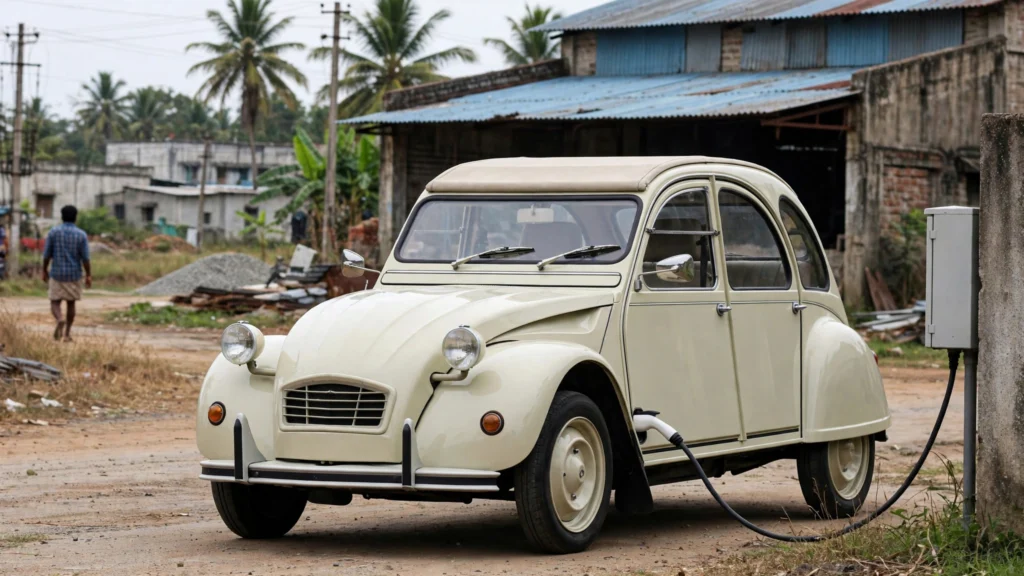
The styling nods to the original: round headlights, a curved roofline and a fabric sunroof, but the old air-cooled twin-cylinder petrol engine is replaced by an electric motor.
Why India fits the plan
India is already one of Citroen’s key production hubs outside Europe, alongside Brazil. The Thiruvallur plant in Tamil Nadu builds the C3, eC3, Aircross and Basalt, with more than 95 percent localisation, and exports to eight markets. Stellantis, Citroen’s parent, now fully owns the plant after buying out the CK Birla Group’s stake.
Stellantis plans to lift output at the plant from around 16,000 units this year to more than 43,000 units by 2028, and a new small electric car would help fill that capacity. The company has also committed a fresh Rs 4,000 crore investment in India over three years to fund a wider product push through 2030, including a confirmed A-segment car. An India-EU free trade agreement concluded earlier this year should also make exports to Europe more attractive.
The catch: India may build it before it buys it
Here is the twist: industry watchers believe India is more likely to be the car’s factory than its biggest market, at least at first.
- The A-segment is shrinking. Maruti Suzuki still dominates it with the Alto and S-Presso, Tata offers the Tiago in petrol and electric forms, and several other big brands have walked away.
- Small EVs sell in modest numbers. Even the MG Comet, the closest thing to a 2CV EV on sale here, remains a niche seller.
- The price maths is tough. A car priced at around 15,000 euros in Europe would cost well above what Indian buyers pay for entry-level electric cars.
- The supplier base is still young. Local suppliers for electric components are still maturing, and reports suggest the motor could come from Leapmotor, the Chinese EV maker in which Stellantis holds a stake.
None of that kills the idea. The 2CV EV could first be an export story, a car built in Tamil Nadu for European streets, with an Indian launch following if costs allow.
A full circle moment
This is not the first time the 2CV has been linked to India. In the late 1980s, Escorts wanted to tie up with Citroen to build the original 2CV here, but approval never came under the licensed industry regime of the time. The original car, built from 1949 to 1990, was affordable, frugal transport for people on low incomes, famously designed to carry a basket of eggs across a ploughed field without breaking any. Nearly four decades later, the name could finally reach Indian factories, this time as an electric car.
What else Citroen has planned for India
The 2CV EV is only one piece of a bigger plan. Citroen will add a C-segment SUV and a D-segment MPV to its Indian range by 2030, joining the C3, eC3, Aircross, Basalt and C5 Aircross, and will lead Stellantis’s push into CNG in India. For now, the eC3 remains the immediate electric focus. Stellantis India chief executive Shailesh Hazela has said: “We will be investing not only in product, not only in manufacturing, not only in localisation but also in increasing our customer experience.”
FAQs
Is the Citroen 2CV EV confirmed for production in India?
No, not yet. Reports say Citroen is evaluating India as a production base for local sale and export, but the company has not officially confirmed the plan.
When will the 2CV EV launch?
The showroom car is due in Europe in 2028. Any Indian launch timeline has not been announced.
How much will the 2CV EV cost?
The European starting price is expected to be around 15,000 euros. An Indian price has not been announced.
Where would the 2CV EV be built in India?
The likely site is Citroen’s Thiruvallur plant in Tamil Nadu, which already builds the C3, eC3, Aircross and Basalt and exports to eight markets.
What was the original Citroen 2CV?
An affordable, frugal small car built from 1949 to 1990, famous for its soft ride and simple engineering.
For now, the 2CV EV remains a plan under evaluation, not a car you can book. But if the reports prove right, one of motoring’s great comebacks could have a very Indian chapter.