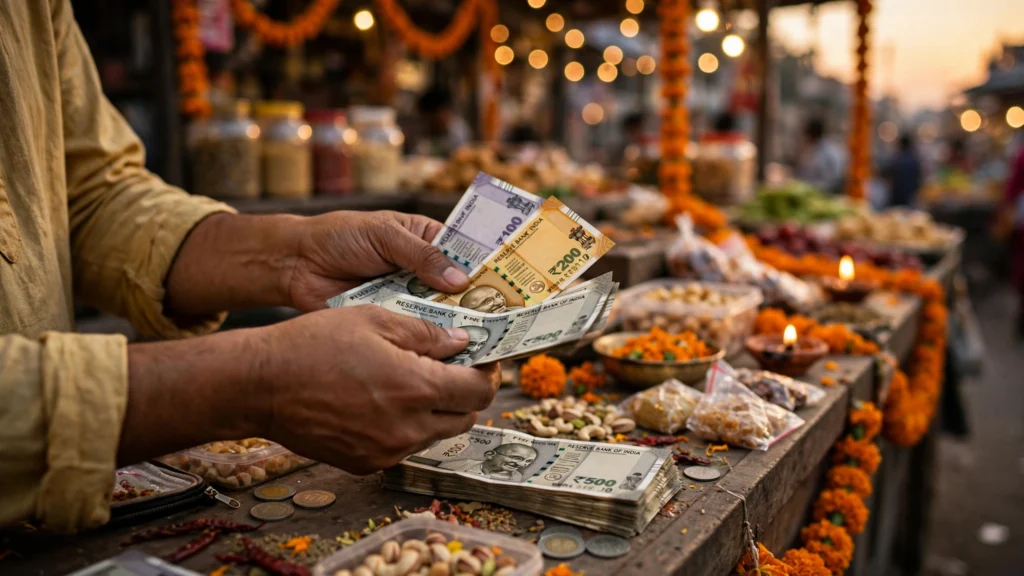
Indians are holding more cash than they have at any point in the last five years. Currency in circulation climbed 13.5 per cent year on year to Rs 43.46 lakh crore as of October 15, 2026, according to the Reserve Bank of India’s latest State of the Economy report, marking the fastest growth in cash with the public since 2021.
The surge has pushed reserve money, the foundation of the money supply, up 10.3 per cent to Rs 53.24 lakh crore. Behind the numbers sits a story of dollar inflows, a central bank that spent much of the last year pumping liquidity into the system, and a festive season that sends cash demand soaring.
What the RBI data actually show
The RBI’s report, authored by its staff economists, notes that reserve money adjusted for changes in the cash reserve ratio expanded at a robust pace, with currency in circulation recording its highest print over the past five years as of September 30, 2026. Growth had already touched 13.3 per cent in the fortnight ended September 30, before quickening further to 13.5 per cent by mid-October.
Currency in circulation counts all banknotes and coins held by the public and in bank branches, outside the RBI’s own vaults. It rises when people withdraw more cash, and it tends to spike around festivals, harvests and weddings, when spending shifts toward cash transactions in markets and small towns. October is peak festive season in India, and cash demand typically jumps in the weeks before Diwali as households shop, traders stock up and employers pay bonuses.
Where the money came from: the FCNR(B) flood
The deeper driver is not festive shopping at all. It is a flood of foreign currency deposits that entered the banking system earlier this year.
On June 8, the RBI opened a special dollar-rupee swap facility covering Foreign Currency Non-Resident (Bank), or FCNR(B), deposits, external commercial borrowings and overseas foreign-currency borrowings. The window was designed to pull dollars into the country at a time when the rupee was under pressure and global conditions were tight.
It worked, dramatically. Banks mobilised $133 billion through FCNR(B) deposits by August 31, when the window closed. Those inflows swelled the RBI’s reserves and, through the mechanics of the swap, added to reserve money and liquidity in the domestic system. The central bank had already been infusing liquidity through other routes: in the 2025-26 financial year it net bought Rs 8.8 lakh crore of government securities through open market operations, according to IDBI First Bank chief economist Gaura Sen Gupta, and it kept infusing liquidity through swap windows into the current year.
Why the RBI is now tapping the brakes
The same report that records the cash surge also signals a shift. With the central bank now starting to drain liquidity, economists expect reserve money growth to moderate in the coming months.
The logic is straightforward. The heavy lifting, defending the rupee, steadying markets and supporting growth, is largely done. Leaving too much liquidity sloshing around for too long risks stoking inflation, which the RBI’s October bulletin already flags as a growing concern, with headline consumer inflation around 5.5 per cent in September.
What it means for you
- Cash availability: ATMs and bank branches are well stocked for the festive season, so withdrawal crunches are unlikely even as demand peaks.
- Loan rates: tighter liquidity and higher CD rates can push up banks’ funding costs, which may slow the pace of any fall in lending rates.
- Deposits: banks competing for funds in a tighter market may offer better rates on fixed deposits in the coming months.
- Inflation watch: strong cash growth alongside rising food and fuel prices is one reason the RBI is cautious about cutting rates too quickly.
- The rupee: the FCNR(B) inflows that drove this surge also helped steady the currency during a volatile period for global markets.
The bigger picture is reassuring in one sense and cautionary in another. The economy is generating enough demand that cash use is growing at its fastest in five years, and the RBI’s dollar operations gave the financial system a deep buffer. But the central bank’s pivot toward draining liquidity is a reminder that the easy-money phase of the last year is ending.
FAQs
What is currency in circulation?
It is the total value of banknotes and coins held by the public and in bank branches, outside the RBI. It is the most visible part of the money supply.
How much cash is in circulation in India now?
Rs 43.46 lakh crore as of October 15, 2026, up 13.5 per cent from a year earlier, according to the RBI’s State of the Economy report.
Why did currency in circulation grow so fast?
Mainly because of $133 billion of FCNR(B) deposit inflows attracted by the RBI’s special swap facility, plus festive-season cash demand and earlier open market purchases.
What is reserve money?
Reserve money is currency in circulation plus bankers’ deposits with the RBI and other RBI liabilities. It stood at Rs 53.24 lakh crore, up 10.3 per cent year on year, and forms the base for broader money supply.
Will the RBI keep draining liquidity?
Economists expect reserve money growth to moderate as the central bank withdraws liquidity, though festive demand may keep cash growth elevated in the near term.
How the RBI handles the unwind will shape borrowing costs into the new year.