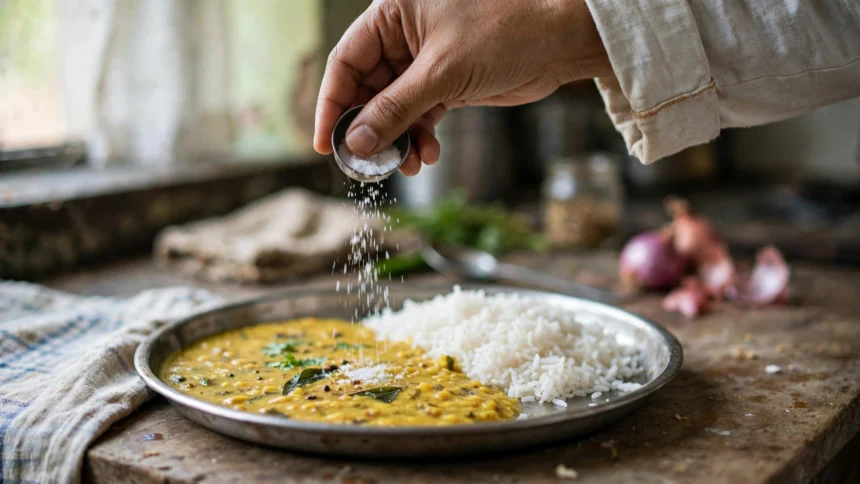
The salt sitting in your kitchen right now could be doing far more damage than most of us realise. A major international study published this week says that a simple swap at the dinner table, replacing ordinary table salt with a potassium-enriched version, could prevent nearly 400,000 deaths every year in India alone.
The research, published in the journal Nature Health on November 4, looked at what would happen if the salt supply across 193 countries switched from regular sodium chloride to potassium-enriched salt. Globally, such a switch could prevent around 2.96 million deaths and more than 10 million new cases of heart and kidney disease each year. India would be among the biggest beneficiaries anywhere in the world.
What the study found
Researchers from The George Institute for Global Health, the University of New South Wales and Johns Hopkins University modelled five different rollout scenarios. The headline scenario, a complete switch of all cooking and industrial salt, produced the largest gains. For India, the model projected about 399,884 deaths prevented every year, along with roughly 1.52 million new cases of cardiovascular and chronic kidney disease avoided.
The study also tested a more targeted approach. If 80 per cent of people with diagnosed and treated high blood pressure switched to potassium-enriched salt at home, the researchers estimated that almost 600,000 deaths and 1.7 million cases of disease could be prevented globally each year. Professor Bruce Neal of The George Institute said the switch could potentially prevent one in every 10 cardiovascular deaths in most countries.
Why India stands to gain the most
India eats far more salt than it should. A 2026 review of 83 studies put average daily salt intake in India at 9.01 grams, nearly double the World Health Organization limit of 5 grams a day. Much of that salt goes into home cooking, which is exactly where a potassium-enriched substitute would do its work.
The stakes are high. The landmark ICMR-INDIAB study found that about 35.5 per cent of Indian adults, roughly 315 million people, live with hypertension. High blood pressure is the single biggest driver of heart attacks and strokes. A small change in the salt shaker, multiplied across hundreds of millions of kitchens, adds up to an enormous public health effect.
The idea is not only a computer model. A 2021 trial published in The Journal of Nutrition followed 502 adults with high blood pressure across seven rural villages in India for three months and found that potassium-enriched salt lowered blood pressure. The World Health Organization endorsed it in 2025 as a strategy to cut blood pressure and cardiovascular risk.
How potassium-enriched salt works
Ordinary table salt is sodium chloride. Potassium-enriched salt replaces part of that sodium chloride with potassium chloride. It tastes very similar in cooking, but it attacks high blood pressure from both sides at once: less sodium coming in, and more potassium, which helps relax blood vessel walls and flush out excess sodium.
- Less sodium: cutting sodium is the most direct way to lower blood pressure.
- More potassium: most Indians eat too little potassium, and raising intake helps the heart and blood vessels.
- Easy to find: low-sodium salt is already sold in supermarkets and online across India.
Who should be careful
Potassium-enriched salt is not suitable for everyone, and the researchers were clear about that. People with serious kidney disease, and those taking medicines that raise blood potassium levels, should take precautions before switching. Professor Vivek Jha, a nephrologist at The George Institute in India, stressed that these groups need medical advice first.
The WHO guidance also excludes children and pregnant women. For most healthy adults, though, the swap is considered safe, and the potential benefit is large.
What this means for your kitchen
For most households, the change is almost absurdly simple. Next time you buy salt, pick up a low-sodium, potassium-enriched pack and check the label for potassium chloride. Use it exactly as you would use regular salt.
That said, a salt swap is not a licence to eat more salt overall. The goal is still to keep total intake close to the WHO limit of 5 grams a day, and no single food can fix high blood pressure on its own.
FAQs
What is potassium-enriched salt?
It is regular table salt in which part of the sodium chloride has been replaced with potassium chloride.
How much salt should Indians eat each day?
The WHO recommends no more than 5 grams a day. The average Indian eats about 9 grams a day, nearly double that limit.
Is low-sodium salt safe for everyone?
Not everyone. People with serious kidney disease, and those on medicines that raise potassium levels, should consult a doctor first.
Will switching salt alone fix high blood pressure?
No. It helps, but blood pressure also depends on diet, weight, exercise, alcohol and medication. Think of the salt swap as one simple step, not a cure.
Where can I buy potassium-enriched salt in India?
Low-sodium salt is sold in most supermarkets and online grocery stores, usually labelled low-sodium or potassium-enriched. Check the ingredients for potassium chloride.
Note: This article is for general information only and is not medical advice. If you have kidney disease or take medication that affects potassium levels, speak to your doctor before switching salts.
Stay with Informeia for the latest health stories that matter to Indian families.