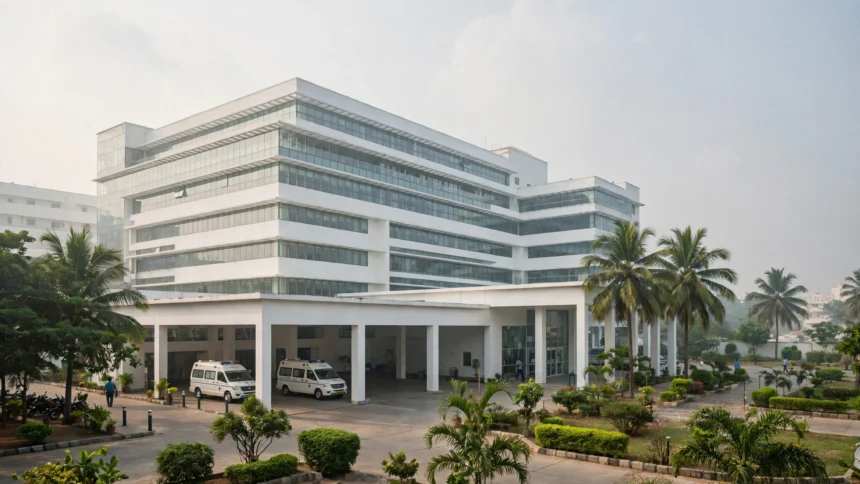
Puducherry’s Jawaharlal Institute of Postgraduate Medical Education and Research, better known as JIPMER, received one of its biggest upgrades on Saturday. Union Health Minister J.P. Nadda dedicated seven new healthcare, research and student-care facilities worth Rs 172.27 crore to the nation at the institute’s 15th convocation, and announced that India plans to add 75,000 undergraduate and postgraduate medical seats by 2029.
The announcement matters far beyond Puducherry. The new facilities target two of India’s heaviest disease burdens, cancer and heart disease, while the seat expansion speaks directly to the lakhs of students who sit for medical entrance exams every year.
What JIPMER got: seven projects worth Rs 172 crore
The Rs 172.27 crore package covers treatment, research, diagnostics and student life. The centrepiece is a Rs 30.28 crore Centre for Research, Innovation and Entrepreneurship, built around advanced platforms for genomics, proteomics and metabolomics.
The package also includes a 400-bed boys’ hostel, a 64-slice CT scanner for JIPMER’s unit at Yanam, and three new AMRIT pharmacy outlets, where patients can buy medicines and implants at subsidised rates. At the convocation, 816 students received degrees, 592 in doctoral, medical, dental and super-specialty courses and 224 in nursing, public health and allied health disciplines.
Cancer care and heart care get the sharpest upgrade
Two of the seven projects are aimed squarely at the diseases that kill the most Indians and cost families the most money. At JIPMER’s Regional Cancer Centre, a new radiation oncology suite worth about Rs 35 crore pairs a Varian TrueBeam high-energy linear accelerator, costing around Rs 26 crore, with an advanced 4D CT simulator worth about Rs 9 crore. The unit is expected to treat roughly 70 cancer patients a day, cutting waiting times for precision radiotherapy.
Alongside it, a Rs 60 crore Cardiac Catheterisation Laboratory Complex has opened with biplane and single-plane cath labs, a dedicated radial suite and a post-cath cardiac critical care unit whose capacity has doubled from 8 to 16 beds. The radial suite lets cardiologists reach blocked heart arteries through the wrist rather than the groin, which lowers bleeding risk and shortens recovery.
75,000 more medical seats by 2029
The bigger headline from Nadda’s address was the national one. The government is working to add 75,000 undergraduate and postgraduate medical seats by 2029, he said, while keeping quality intact.
The numbers tell the story. Medical colleges have grown from 387 to 863, MBBS seats from about 51,000 to 1.43 lakh, postgraduate seats from around 31,000 to more than 91,000, and the number of AIIMS from six to 23. JIPMER itself performed more than 46,815 surgeries in the 2025-26 clinical year.
Nadda also pushed young doctors to go digital, urging them to adopt e-prescriptions and ABHA-linked digitisation of patient records, so a patient’s history travels with them, with their consent, from one hospital to the next.

Why it matters
The JIPMER upgrade is best read as two announcements in one. The first is about capacity where it hurts most. Cancer and cardiac care are where Indian families face the worst combination of long waits and ruinous bills, and both new units are designed to treat more patients, faster, in the public system. A machine that treats 70 patients a day and a cath lab that sends people home sooner are throughput projects, and throughput is what a crowded public hospital needs.
The second is about the pipeline of doctors. Adding 75,000 seats by 2029 sounds abstract until it is set against the entrance-exam reality: every year, lakhs of aspirants compete for a fraction of the seats available, and the shortage shows up as overcrowded outpatient departments and overworked junior doctors. The expansion from 51,000 to 1.43 lakh MBBS seats over the past decade has not yet closed that gap, which is why the next tranche matters, and why the minister’s insistence on maintaining quality alongside growth will be the real test. For NEET aspirants, the new seats will arrive in tranches, and the official seat matrix, not the headline number, is what to watch.
FAQs
What did JIPMER get in the Rs 172.27 crore upgrade?
Seven facilities, including a Rs 30.28 crore research centre, a Rs 35 crore radiation oncology suite, a Rs 60 crore cardiac cath lab complex, a CT scanner at Yanam, a 400-bed hostel and three AMRIT pharmacies.
How many medical seats will India add by 2029?
The government plans to add 75,000 undergraduate and postgraduate medical seats by 2029, on top of the growth that has already taken MBBS seats from about 51,000 to 1.43 lakh.
When were the JIPMER projects inaugurated?
Union Health Minister J.P. Nadda dedicated the projects on Saturday, 21 November 2026, during JIPMER’s 15th convocation in Puducherry.
What is the TrueBeam machine at JIPMER?
It is a high-energy linear accelerator used for precision radiotherapy in cancer treatment. Paired with a 4D CT simulator, the new unit is expected to treat around 70 cancer patients a day.
What are AMRIT pharmacies?
AMRIT outlets sell medicines and implants at subsidised rates. Three new outlets have opened at JIPMER, in the Super Speciality Block, the SSB Annex and the Regional Cancer Centre Annex.
JIPMER’s upgrade and the national seat expansion will be watched closely in the months ahead, by patients waiting for treatment and by students waiting for a seat. What matters now is how fast the new facilities start treating patients, and how quickly the promised seats actually appear.